
Safe calls in the Manhattan area
From about 1780 to 1830 the Kaw, or Kansa, lived at Blue Earth Village where the Big Blue River meets the Kansas River, and an 1819 drawing of a Kansa lodge here is the oldest known drawing made in Kansas. After the Kansas–Nebraska Act, George S. Park started a settlement called Polistra in 1854 and Samuel D. Houston and three others founded Canton nearby. In the spring of 1855, Free-State settlers sent by the New England Emigrant Aid Company and led by Isaac Goodnow joined the two claims into a town they called Boston. That June the steamboat Hartford ran aground in the Kansas River with 75 Ohio settlers of the Cincinnati-Manhattan Company aboard, bound farther upriver. They agreed to stay if the town took their company's name, and on June 29, 1855, Boston became Manhattan. The town was incorporated in 1857 and named the Riley County seat in January 1858, and the Methodist Blue Mont Central College chartered that February became, in 1863, Kansas State Agricultural College, often counted as the first land-grant college to open under the Morrill Act. Today Kansas State University is the city's largest employer, and its students fill Aggieville, the shopping and nightlife district beside campus. The Kansas Pacific arrived in 1866, and on April 24, 1867, the strongest earthquake ever centered in Kansas shook the town. Manhattan sits on a floodplain, and after the 1951 flood the Big Blue was dammed to form Tuttle Creek Lake; during the 1993 flood its emergency spillway gates were opened for the only time. Tornadoes hit the city in 1966 and again on June 11, 2008, when an EF4 damaged homes, businesses and campus buildings. Manhattan calls itself the Little Apple. It was the first Kansas city named an All-America City, in 1952, it was home to the state's first television station in 1932, and Damon Runyon was born here. The Flint Hills Discovery Center tells the story of the tallgrass prairie, the Konza Prairie preserve is owned by The Nature Conservancy and K-State, and many soldiers and civilians from Fort Riley, home of the 1st Infantry Division, live in town. The National Bio and Agro-Defense Facility and the Kansas Department of Agriculture now have offices here too.
Passports, visas and visa papers for international students and scholars
Students, researchers and visiting faculty from overseas carry some of the hardest papers to replace: a passport with a visa stamped inside, an I-20 or DS-2019, an employment authorization card, and the letters and receipts that go with them. Losing them can mean appointments with an embassy and the school's international office, sometimes far from campus. A small bolt-down safe or lockbox in an apartment or dorm room is a good home for the originals between trips. Keep scans or photos in a secure online folder too, and write the passport and document numbers on a card kept somewhere else. If you rent, ask the landlord before bolting anything to the floor or a wall, and choose a combination you'll remember after a long trip home. Don't keep the passport in a car, a backpack left in a lab, or a box with the key taped to it. When you graduate or move, empty the safe and reset it to the factory code before you sell it or leave it behind.
Burn season in the Flint Hills: safes in shops and outbuildings
Ranchers in the Flint Hills burn the tallgrass prairie most springs, and a burn that jumps a firebreak or a wildfire on a dry, windy day can reach a shop, barn or ranch office in a hurry. A fire-rated safe is tested for a set time at a set temperature, and a building full of hay, fuel and equipment can burn hotter and longer than that. Before burn season, mow or clear a strip around the building, keep hay and fuel cans away from the wall the safe stands against, and move deeds, cattle records, titles and spare keys you couldn't replace to the safe in the house. If fire does reach a building with a safe in it, let the safe cool for a day or more before you try to open it, since opening a hot safe can let air in and char papers that made it through. Don't spray water into the door gap, and if the handle or dial is stiff after a fire, don't force it.
Safe services in Manhattan
- Safe lockouts and openings (forgotten combinations, dead keypads, failed electronic locks, lost keys)
- Combination changes and lock replacement (dial, electronic and key locks)
- Estate and inherited safes, with proper paperwork
- Safe installation: positioning and anchoring where the safe and floor allow it
Safes and master key systems only outside the Springfield area. Car, home and business lockouts, car keys, single-lock rekeys and lock installation are offered only in Springfield, nearby towns, and Branson.
Master key systems in Manhattan
Manhattan's rental houses and apartment buildings, offices, clinics, churches and shops around Aggieville and downtown turn keys over every school year. A master key system lets each tenant or employee carry one key while managers keep a master, and a lost key means rekeying only what it opened.
Besides safes, master key systems are the one service we take to Manhattan. A master key system, also called master rekeying, means we plan who should open which doors, then rekey your locks so each person's key opens only what they need and a master key opens everything. When someone leaves or a key goes missing, the locks that key opened can be rekeyed without changing everyone else's keys. See master key systems and master rekeying for how it works.
Scheduling a safe job in Manhattan
When you call, tell us the safe brand, the lock type (dial, keypad or key), roughly how big it is, what happened, and where it is. We'll quote the job and set a time with you. Because regional safe jobs are planned around our other work, please call ahead rather than expecting same-day service.
We open safes only for owners or people with legal authority. Have your ID and proof of ownership, or estate paperwork, ready.
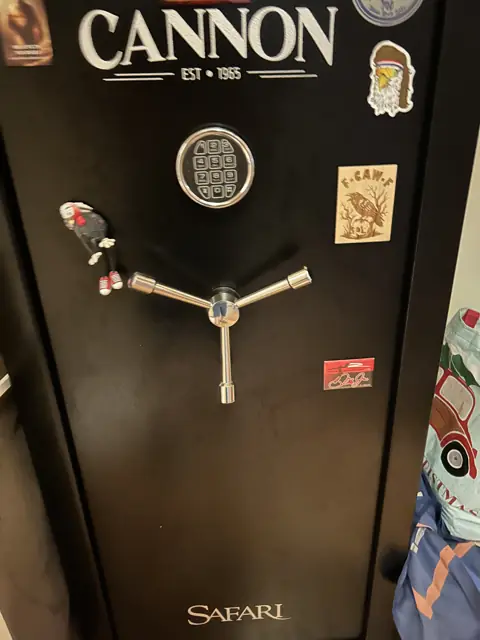
For more on the work itself, including lockouts, combination changes and installation, see our safe locksmith service page. To see what a safe opening looks like, watch us open a locked Cannon gun safe.
Safes we've worked on
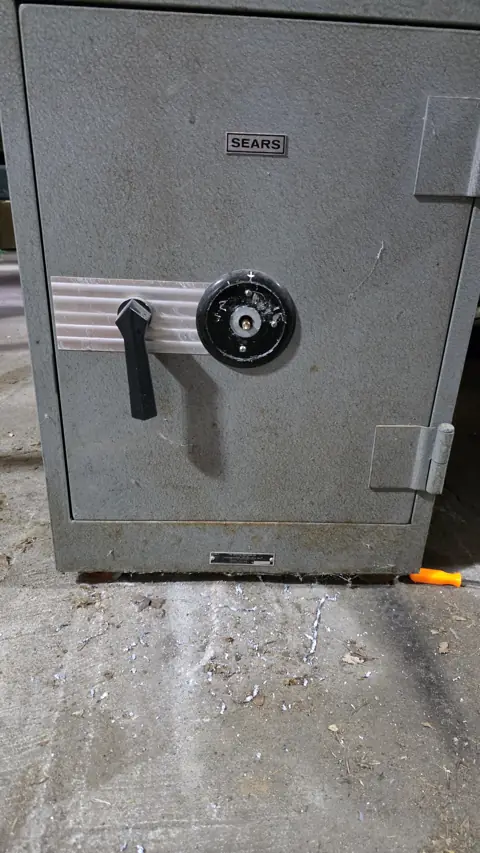
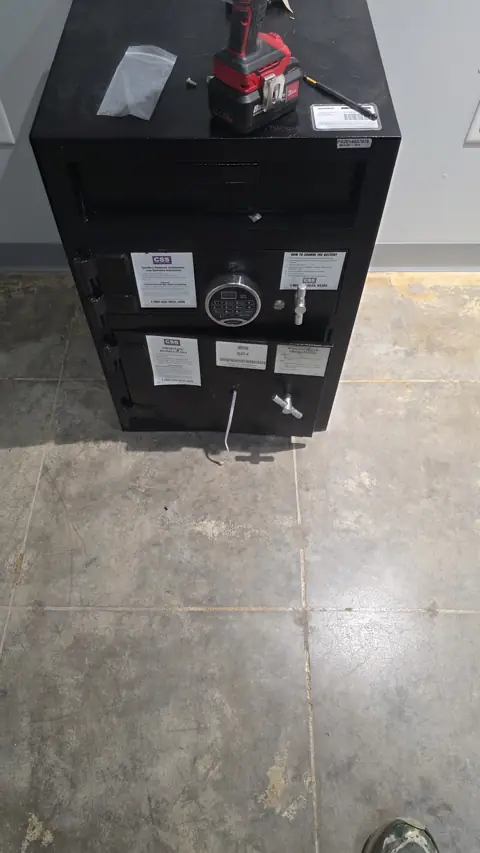
A few real safe jobs from our recent work.
Nearby safe service areas
We also take safe jobs in Westmoreland, KS, Junction City, KS, Alma, KS. See the full list of safe service cities.
Manhattan safe FAQs
I'm an international student at K-State, and my passport and I-20 are locked in a lockbox in my apartment. The combination isn't working. Can you open it?
Usually, yes. Call (417) 590-3870 with a photo of the box and any brand name. We'll need to see that the box is yours, such as your lease, a purchase receipt, or the school's international office vouching for you, since your ID may be inside. We quote first and schedule once you approve.
A pasture fire got close to our shop near Manhattan, and now the safe's dial is stiff. Can you open it?
Usually, yes. Let the safe cool completely first and don't force the dial or handle. Call with the brand, the lock type and photos of the safe and the dial, and we quote first and schedule once you approve. If the safe took real heat, plan on replacing the lock or the safe after it's open.
Do you set up master key systems for businesses in Manhattan?
Yes. Master key systems, also called master rekeying, are the one service besides safe work that we take to Manhattan. Call (417) 590-3870 with the type of building, roughly how many doors, and who needs access to what. We'll quote it and schedule a time with you.
Do you do other locksmith work in Manhattan?
No. In Manhattan we only do safe work and master key systems. Our car and home lockouts, car keys and other everyday services are limited to Springfield, MO, nearby towns, and Branson.
How much does safe work cost in Manhattan?
It depends on the safe, the lock and the job. Call (417) 590-3870 with the details and we'll quote it before we schedule.